

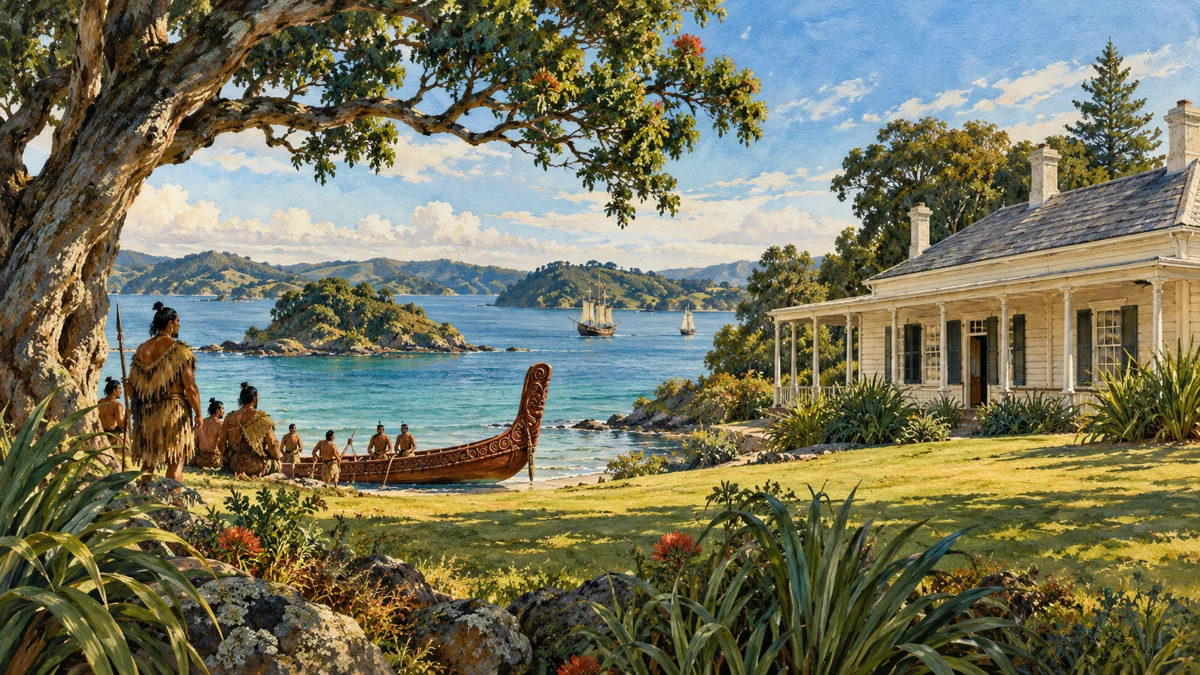
A Brief History of New Zealand
A brief historical overview of New Zealand—a country with a unique cultural heritage of Māori and European influences. Key dates, events, and achievements from ancient times to the present day are presented.
- The Māori arrived in New Zealand from Polynesia around 1250.
- The Māori call the country Aotearoa, “Land of the Long White Cloud.”
- The first Europeans to see the islands were the Dutch, led by Abel Tasman (1642).
- In 1769, Captain James Cook explored the coast and made maps.
- In 1814, the first Christian missionaries arrived in the country.
- In 1835, the Māori signed the Declaration of Independence.
- In 1840, the Treaty of Waitangi was signed between the Māori and Britain.
- In 1841, New Zealand became a separate British colony.
- The New Zealand (Land) Wars took place from 1845 to 1872.
- In 1865, Wellington became the capital of New Zealand.
- Large-scale European immigration began in the 1870s.
- Railways began to develop actively in the 1870s.
- In 1893, New Zealand became the first country to grant women the right to vote.
- The first pension system was introduced in 1898.
- In 1907, the country received dominion status within the British Empire.
- In 1914, New Zealand entered the First World War.
- New Zealand soldiers fought in the Battle of Gallipoli in 1915.
- ANZAC Day has become an official day of remembrance for fallen soldiers.
- In 1935, the first Labour government came to power in the country.
- In World War II, New Zealand again supported Great Britain.
- The soldiers took part in campaigns in North Africa, Italy and the Pacific.
- In 1947, the country gained full legislative independence.
- In 1951, New Zealand became a member of ANZUS, a defence alliance with Australia and the United States.
- In 1953, the Tangiwai rail disaster, caused by a lahar from Mount Ruapehu, killed 151 people.
- In 1953, Edmund Hillary and Tenzing Norgay made the first confirmed ascent of Mount Everest.
- In the 1960s, New Zealand participated in the Vietnam War.
- In 1967, the switch from pounds to New Zealand dollars took place.
- In 1975, the Waitangi Tribunal was established to hear complaints from Māori.
- In 1975, the Māori Land March took place.
- In 1981, the country was rocked by protests against the tour of the South African rugby team.
- In 1984, the Lange government began radical economic reforms.
- In 1985, nuclear ships were banned from entering territorial waters.
- New Zealand withdrew from ANZUS but remained an ally of the United States and Australia.
- In 1990, the country celebrated 150 years since the signing of the Treaty of Waitangi.
- In 1993, the law on the proportional electoral system (MMP) was adopted.
- In 1996, elections were held for the first time under the MMP system.
- In 1999, Helen Clark became the first female prime minister elected at a general election.
- In 2004, the Marine and Coastal Zones Act was passed.
- In 2010, a devastating earthquake struck Christchurch.
- In 2011, another earthquake killed 185 people.
- Rocket Lab’s first Electron test launch from New Zealand took place in 2017.
- In 2017, Jacinda Ardern became Prime Minister.
- In 2019, a terrorist attack occurred at a Christchurch mosque, killing 51 people.
- After the tragedy, gun laws were tightened.
- In 2020, New Zealand successfully managed the COVID-19 pandemic.
- Ardern was re-elected to a second term in 2020.
- Many world leaders have praised the country for its humane leadership and stability.
- Te reo Māori gained official language status in 1987.
- In 2024, the Māori elected a new symbolic queen.
- Māori language and culture are supported through educational initiatives.
- Archaeologists have discovered traces of the first Māori settlements dating back more than 700 years.
- Mount Cook is the highest point in the country, named after James Cook.
- New Zealand is one of the first countries to legalise same-sex marriage (2013).
- Rugby is considered the country’s national sport.
- The All Blacks are one of the strongest rugby teams in the world.
- Māori culture has been actively revived since the 1970s.
- The haka, a traditional Māori war dance, has become an international symbol.
- Tourism has become a key economic sector in the 21st century.
- The islands have unique flora and fauna, including the kiwi bird.
- The kiwi is the national symbol of New Zealand.
- New Zealand is actively combating climate change.
- Many cities in the country are included in lists of the most comfortable to live in.
- The capital, Wellington, is known for its arts scene and film industry.
- Auckland is the country’s largest city and economic centre.
- The Māori New Year, Matariki, became an official holiday in 2022.
- The North and South Islands have different climatic conditions.
- The official languages are English, Māori and New Zealand Sign Language.
- Fiordland National Park is a UNESCO World Heritage Site.
- The famous Lord of the Rings films were filmed in New Zealand.
- Peter Jackson, director of The Lord of the Rings, is from Wellington.
- Film-based tourism is an important part of the economy.
- New Zealand is a parliamentary democracy with the King as head of state.
- King Charles III is the official monarch of New Zealand.
- The Governor-General represents the King in the country.
- The country’s constitution is not written down in a single document; it consists of laws and traditions.
- The country is a member of the Commonwealth of Nations.
- New Zealand actively participates in UN peacekeeping missions.
- More than 16% of the population is Māori.
- The country has many immigrants from Asia and the Pacific region.
- New Zealand has been ranked as one of the least corrupt countries in the world.
- Christchurch is known as “the most English city outside England.”
- Dunedin was founded by Scots and retains a cultural influence.
- The first university, Otago, was founded in 1869.
- New Zealand has high levels of literacy and education.
- The state actively promotes ecotourism and nature protection.
- Over 30% of the country’s territory is protected natural areas.
- New Zealand does not have nuclear weapons and is abandoning nuclear power.
- New Zealand does not operate nuclear power stations.
- The country relies primarily on hydropower and renewable energy sources.
- Environmental protection is a prominent part of New Zealand’s national identity.
- The country continues to work actively to preserve Māori cultural heritage.
- Young people are increasingly learning the Māori language in schools.
- New Zealand is an example of peaceful coexistence between indigenous and immigrant cultures.
- The country’s residents are famous for their openness, tolerance and love of nature.
- New Zealand is a country with a unique development path and a deep respect for its roots.
Illustrations show the character of the places and are not documentary photographs. Opening hours, admission prices and access conditions can change; check the attraction’s official information before booking.