

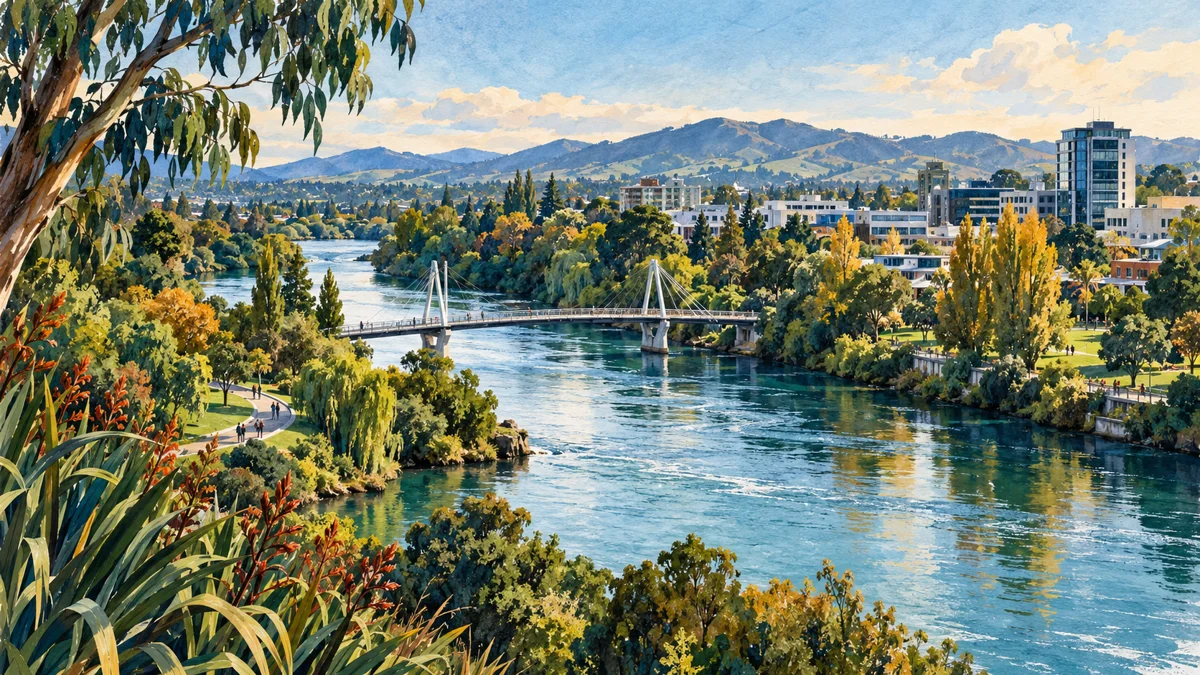
City of Hamilton (New Zealand)
Hamilton (Kirikiriroa in Māori) is New Zealand’s fourth-largest city, located in the heart of the Waikato region on the North Island. It’s a vibrant, green, and innovative destination that offers visitors a rich history, culture, and beautiful green spaces. This guide covers its history, people, gardens and places to visit.
1. History and origin
Hamilton was founded in 1864 as a military settlement during the war with the local Māori during the conquest of the Waikato region (Interesting Facts, Wikipedia). Its current name honors Captain John Fane Charles Hamilton, who died at the Battle of Gate Pā in the 1860s (Wikipedia).
The site was originally home to several Māori villages, including Kirikiriroa, whose original name means “long stretch of gravel” or “wide lawn” in Māori (Wikipedia). In 2020, municipal authorities decided to remove the Hamilton statue, and discussions about restoring the historic name to Kirikiriroa are still ongoing (Wikipedia).
2. Modernity: Demography, Education, and Economics
Today, Hamilton is a city with a thriving economy centreed on education, research, and agritech. Home to the University of Waikato and numerous research institutes, the city boasts over 40,000 students and approximately 1,000 PhD holders (Wikipedia, Explore Hamilton).
Agri-tech is a leading industry, with Hamilton being called the agri-tech capital of New Zealand (Explore Hamilton).
Another highlight: Hamilton is home to Fieldays, the southern hemisphere’s largest agricultural exhibition, which attracts over 130,000 visitors annually and showcases the latest agricultural technologies and solutions (Explore Hamilton, Interesting Facts).
3. Population and cultural composition
According to the latest data, the exact population figure for the entire city is higher, but the emphasis is on the central areas. The central business district (CBD) in 2023 was estimated to have a population of approximately 2,628, a 39% increase since 2013 (Wikipedia).
There are different groups represented: 56% are European (Pākehā), 22% are Māori, 27.7% are of Asian descent, 4.5% are Pasifika Islanders, and about 3.5% are from the Middle East, Latin America and Africa.
Hamilton is multilingual: English is the main language (95.7% of speakers), but 6.3% understand Māori, and about 24.5% speak other languages. Approximately 39.4% of the population was born outside of New Zealand.
This mix of cultures creates a vibrant and friendly atmosphere where Māori, Asian and European cultures blend into a contemporary urban landscape.
4. Garden Cities: Hamilton Gardens
Hamilton’s most iconic symbol is Hamilton Gardens, a complex of gardens that attracts over a million visitors annually, nearly half of whom are tourists (Wikipedia).
The park covers approximately 54 hectares along the Waikato River and consists of 28 themed gardens, grouped into collections: Paradise, Productive, Fantasy, Cultivar and Landscape (Wikipedia, New Zealand).
- Paradise: Japanese garden of contemplation, Chinese garden for thoughtful reflection, English flower garden, Italian Renaissance garden, Indian “Char Bagh” and American modernist garden (New Zealand, Wikipedia).
- Fantasy: The Surreal Garden and the Picture Garden, with references to Mozart and The Magic Flute (The Magic Flute), are designed for imagination and visual storytelling (New Zealand, Hamilton Gardens).
- Productive: Te Parapara Māori garden, where traditional crops were grown, and historic European kitchen gardens (New Zealand, Hamilton Gardens).
- Cultivar: Roger’s Rose Garden Collection and Victorian Flower Gardens (New Zealand).
New gardens continue to appear: Middle Ages, Pacifica, Baroque and other projects are in development (Momentum Waikato).
The original concept was conceived by architect Peter Sergel, who developed the concept of the gardens as a living museum, telling the story of civilisations through the history of gardening (Hamilton Gardens).
The gardens have won numerous awards including Garden of the Year internationally and Momentum Waikato Park of the Year.
5. Nature and water recreation
The Waikato River, New Zealand’s longest (425 km), flows through the city, holding cultural and historical significance for the Māori (Explore Hamilton, Interesting Facts). Its banks offer walking and cycling trails, as well as opportunities for kayaking and boating (Explore Hamilton).
Lake Rotoroa (Hamilton Lake) is a tranquil 54-hectare body of water popular for walking, running, and sports. It boasts a yacht club, regattas, and waterside walking and cycling trails (Wikipedia).
Another interesting location is the Taitua Arboretum, a botanical garden with exotic and native flora, an ideal place for quiet strolls and picnics (trackstick).
6. Other attractions and cultural life
- Waikato Museum is a regional museum showcasing the history, culture and arts of Waikato (trackstick).
- Hamilton Zoo is a zoo with hundreds of animals and is actively involved in conservation programmes (trackstick).
- Claudelands Events Centre is a centre for large-scale events: concerts, conferences, exhibitions (trackstick).
- The annual Balloons over Waikato festival , the Hamilton Night Market , Matariki (the Māori New Year), the Great Race (an inter-university regatta) and more make the city’s culture rich and diverse (trackstick).
- Nearby is the famous Hobbiton Movie Set , a film set from The Lord of the Rings and The Hobbit, which is available for tours (trackstick).
7. The present and the urban spirit
Hamilton is a city that combines historical depth, green infrastructure, and a future driven by educational and technological advancements. It is developing into a modern hub with a comfortable urban environment and a diverse cultural palette (Interesting Facts, Explore Hamilton).
The city is environmentally proactive: nature restoration programmes, the creation of green corridors, and the enhancement of biodiversity all reflect a commitment to a sustainable future.
Conclusion
Hamilton is more than just a stopover: it’s a vibrant city where history, Māori heritage, green spaces, and learning centres create a unique blend. Here, the art of gardening thrives, Māori culture meets technological innovation, and the river and lake invite outdoor recreation.
- History: From Māori settlements through immigration and war years.
- Demographics: multiculturalism, youth, student energy.
- Economics and education: agritech, university, scientific research.
- Gardens: Hamilton Gardens is a true horticultural museum.
- Nature: river, lake, botanical parks around the city.
- Culture: festivals, museum, zoo, film tours.
For tourists, Hamilton is a garden city, a city of education, a city of discovery. A visit here will evoke the tranquility of water, the dreaminess of a dream garden, and the vibrancy of a cultural mosaic.
Illustrations show the character of the places and are not documentary photographs. Opening hours, admission prices and access conditions can change; check the attraction’s official information before booking.
Plan your visit: Hamilton
How to fit it into your itinerary
Combine a riverside walk with Hamilton Gardens, or use Hamilton as a stop on a Waikato itinerary.
How much time to allow
Half a day for the city; more with gardens and a museum visit.
Before you travel
Check parking, opening hours and admission rules for each selected attraction.
Official information
- Official website: places, tickets and visitor information
- DOC: access restrictions and alerts
- NZTA: roads and journey times
Times are suggested planning allowances, not guaranteed trip durations. Add driving time, stops and a weather buffer separately. Check current tickets, opening hours and access with the operator; attraction tickets are arranged separately from the driver service.