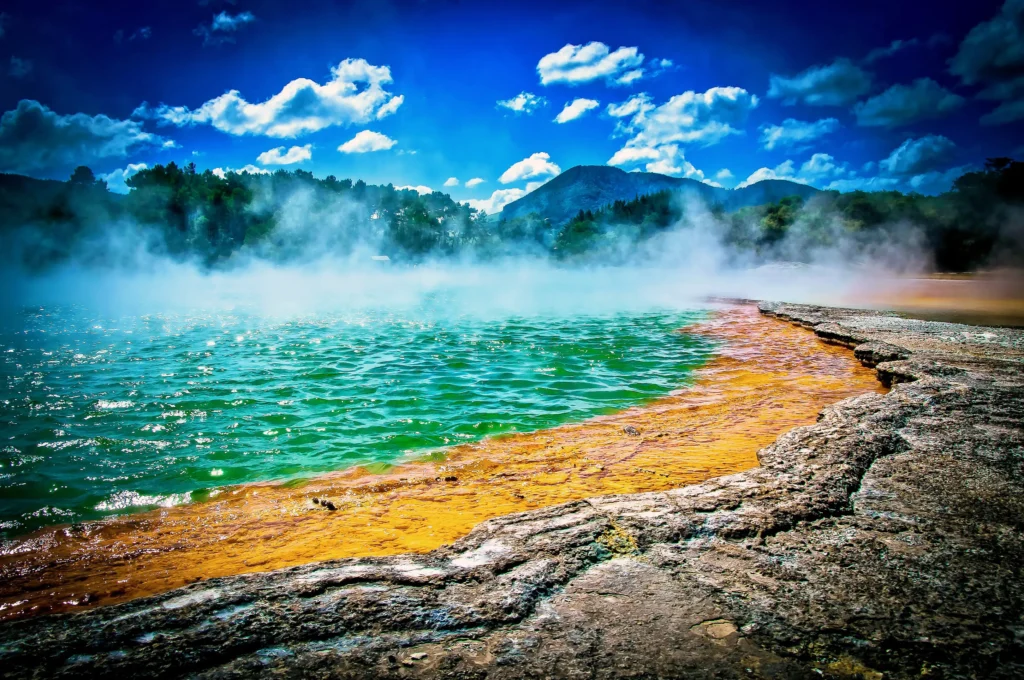


Auckland
Auckland (Tāmaki Makaurau in Māori, meaning “Tāmaki, desired by many”) is New Zealand’s largest city and the country’s main economic, cultural, and transport hub. It is located on the North Island, between two large bays—Waitematā and Manukau Bay. It is often called the “City of Sails” for its numerous yachts and marinas, as well as its picturesque seascapes.
History
- Māori settlement before European arrival:
the region was inhabited by the Māori, who had developed settlements. The land was fertile, indented with bays, inlets, and islands, and the sea was an important part of their culture and economy. The Māori used volcanoes as maunga (high hills/mountains), sometimes as lookout points, settlements, and defense sites. - Colonization:
The 19th century saw the arrival of numerous Europeans; Auckland was founded in 1840, named after George Eden, First Lord of the Admiralty. Until 1865, Auckland was the capital of the British colony of New Zealand, when the capital was moved to Wellington. - Growth and Merger of Administrative Units:
Much of the territory that is now “Auckland” was previously separate cities or districts (North Shore, Manukau, Howick, Rodney, etc.). In 2010, an administrative reorganization took place: all municipalities in the region were merged into a single “supercity”—Auckland Council.
Geography, structure and size
- The Auckland region covers a large area: mountainous, coastal, with many islands, bays and volcanic cones (the Auckland volcanic field contains dozens of maunga).
- Population: approximately 1.8 million people (2023–2024).
- Forecast: by the early 2030s – about 2 million.
- The region is becoming multicultural. Immigration is a key driver of growth. The proportion of residents of Asian and Pacific descent is growing.
Demography and culture
- About 40% of residents were born abroad.
- Ethnic composition: 54% European, 28% Asian, 16% Oceanian, 12% Māori, about 2% Middle Eastern, Latin American and African.
- The city with the largest number of Polynesians in the world.
- About 30% speak two or more languages.
- Religions (2023): 42.7% no religion, 35.7% Christians, followed by Hindus, Muslims, Buddhists, etc.
Economy
Auckland is the country’s central commercial and educational centre.
- It accounts for about 37–40% of GDP and 35–40% of jobs.
- More than 36% are employed in the following sectors: business services, hi-tech, and healthcare.
Main sectors
- Finance, professional services
- Seaport and trade
- Manufacturing: food, beverages, technology, cinema
- Tourism and post-pandemic recovery
Infrastructure and transport
- The country’s largest airport and seaport
- CBD: a centre for business, universities, and culture
- Plans to expand the airport and improve transportation
- Transportation: bridges, roads, ferries, public transport
Politics and Governance
- Auckland Council: Mayor + 20 councillors + local councils
- Mayor (2025): Wayne Brown
- Topics: Housing, Environment, Transport, Māori Heritage
The present and future development prospects
- Population growth puts pressure on infrastructure
- Future Development Strategy – development for 30 years
- Projects: Paerata Rise, Airport Expansion
- Problems: high housing costs, traffic jams, infrastructure, climate
Population, composition and culture
- Multinationality and population growth
- Rich cultural life: theatres, museums, festivals
- Active presence of Māori culture
Attractions and things to see for tourists
- Sky Tower — 328 m, restaurants, observation decks and adventure activities
- Volcanic cones: Mount Eden, One Tree Hill, Rangitoto
- Hauraki Bay Islands: Waiheke etc.
- Waterfront areas: Viaduct Harbour, Wynyard Quarter
- Museums: War Memorial Museum, Art Gallery, Civic Theatre
- Parks: Domain, Albert Park, coastlines, green spaces
- Surroundings: North Shore, Coromandel, lakes, mountains
Policy, management and strategic plans
- Council: Mayor and elected councils
- Local elections every 3 years
- Plans: Auckland Plan 2050, Future Development Strategy
Interesting facts
- The city is built on a volcanic field
- Sky Tower is a prominent landmark on Auckland’s skyline.
- A third of New Zealand’s population lives in Auckland.
- A wide variety of cultures and cuisines
City of Sails
Auckland is nicknamed the “City of Sails”—it has more boats per capita than anywhere else in the world. The annual regatta in January attracts thousands of yachts.
Between two coasts
Coast to Coast Walkway (~16 km) – from the Pacific Ocean to the Tasman Sea in 4 hours.
Sky Tower
At 328 metres, Sky Tower offers panoramic city views. It features observation decks, a revolving restaurant, SkyJump, and SkyWalk.
Pigeon post
The world’s first pigeongram was used on Great Barrier Island after a shipwreck in 1894.
Volcanic network
Dozens of volcanic cones have become parks and lookout points, such as Mount Eden and One Tree Hill.
Why visit Auckland
Auckland is a perfect blend of nature and city life, from cafes and museums to volcanoes and sailing. It’s a city for both relaxation and action.
Practical advice
- Plan your trips taking traffic into account
- Check ferry and tour schedules
- The weather is changeable – dress in layers
- Try Māori cuisine, seafood and wine
Conclusion
Auckland is a city collage of geological wonders, cultural diversity, economic activity, and vibrant life. Despite its challenges, it remains one of the most attractive places to live and visit.
Illustrations show the character of the places and are not documentary photographs. Opening hours, admission prices and access conditions can change; check the attraction’s official information before booking.
Plan your visit: Auckland
How to fit it into your itinerary
Combine the waterfront, central neighbourhoods and one viewpoint in a city itinerary. Plan the west coast as a separate outing.
How much time to allow
Half a day or a day for the city, plus travel from your pickup address.
Before you travel
Check opening hours for your chosen museums and Sky Tower, maunga access and traffic.
Official information
- Official website: places, tickets and visitor information
- DOC: access restrictions and alerts
- NZTA: roads and journey times
Times are suggested planning allowances, not guaranteed trip durations. Add driving time, stops and a weather buffer separately. Check current tickets, opening hours and access with the operator; attraction tickets are arranged separately from the driver service.