

North Island of New Zealand
The North Island is one of New Zealand’s two main islands (the other is the South Island). It covers an area of approximately 113,700 square kilometres and is home to approximately 4–5 million people—roughly 75–80% of the country’s population.
The Māori name is Te Ika-a-Māui , which translates as “The Fish of Māui.” According to legend, the hero Māui fished a large fish—the North Island—from the ocean.
History
Before the Europeans : The population depended on various Māori tribes. They arrived from Polynesia, mastered seafaring, established settlements along the coasts and rivers, and engaged in fishing, hunting, and farming. By the 14th–15th centuries, the North Island was completely inhabited by the Māori.
European arrival and colonization : The first Europeans were explorers like Abel Tasman and Captain James Cook. In the 19th century, the Treaty of Waitangi was signed in 1840—a crucial document through which the Māori and the British Crown attempted to establish a legal framework for their relationship. The European population began to expand rapidly, and agriculture, ports, and trade developed.
20th-21st centuries : Infrastructure and urban development. The urban population grew, with migration from rural areas (including Māori) to cities, the integration of Māori culture into national identity, and legislative efforts to restore rights, language, and land. Tourism became an important industry.
Population and culture
Ethnic composition: predominantly descendants of European settlers, with a significant Māori minority and a growing number of immigrants from Asia and the Pacific Islands.
Languages: English, Māori. The Māori language (te reo Māori) is officially recognized and used in education, names, and ceremonies.
Culture: Māori still play an important role, including ceremonies, connections with nature, songs, dances, and traditional gatherings on marae .
Cities and regions
- Auckland is the largest city, harbour, cultural events, and international hub.
- Wellington is the capital, with museums, theatres and picturesque landscapes.
- Rotorua – geothermal areas, Māori culture, hot springs.
- Taupō – the largest lake, fishing, waterfalls, walking.
- Napier – Art Deco architecture, wineries.
- Coromandel – beaches, bays, hot beaches (Hot Water Beach).
- Bay of Islands / Northland – tropics, historical missions, seaside recreation.
Nature and Geography
Volcanic belts, geothermal zones, lakes, hot springs, coastlines with beaches and bays, waterfalls, and forests. Among them:
- Tongariro National Park – volcanoes Ruapehu, Ngauruhoe, Tongariro.
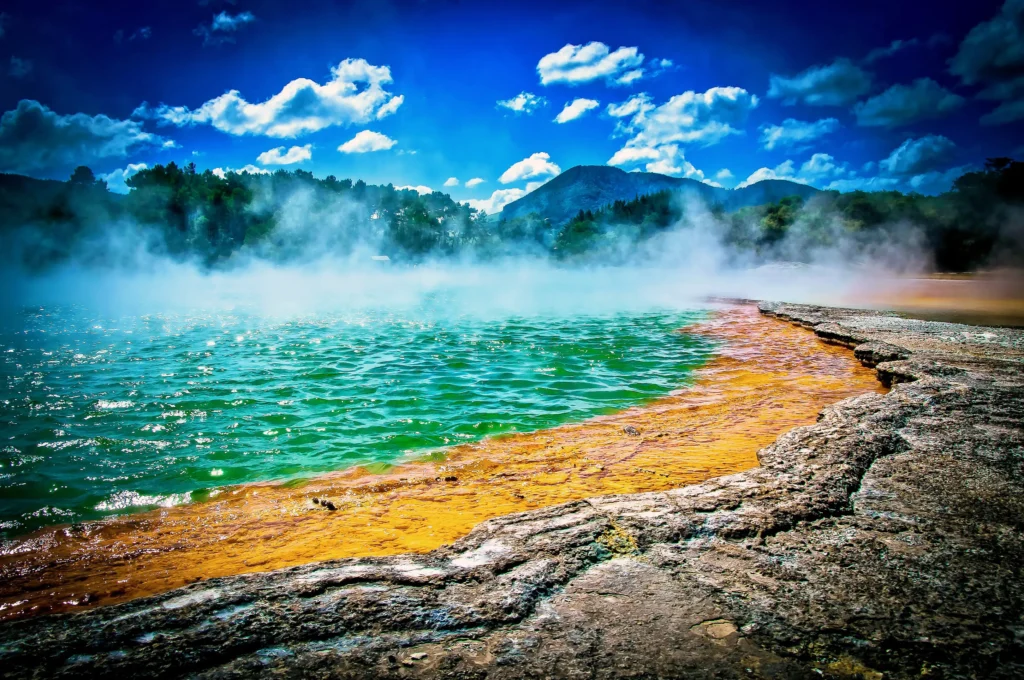
- Wai-o-Tapu – colored geothermal pools, geysers.
- Wairere Falls is the highest waterfall (~153 m).
What to do and what to visit
- Tongariro Alpine Crossing is a hiking route through the volcanic zone.
- Rotorua – geysers, Māori show, mud springs.
- Lake Taupo and Huka Falls – water sports, trekking.
- Coromandel and Hot Water Beach are beaches with hot springs in the sand.
- Bay of Islands – boat trips, dolphin watching.
Current state
Developed infrastructure, tourism, agriculture, and winemaking. Challenges remain: environmental protection, Māori rights, and sustainable tourism development.
Practical advice
- Plan your trip in advance, especially for the New Year holidays.
- Renting a car is the best way to explore the island.
- Have clothes for all occasions – the climate can change.
- Respect Māori culture: learn basic words and rules of conduct.
Interesting facts
- North Island is the 14th largest island in the world.
- The Māori legend of the Maui fish gave the island its name.
- In Napier, after the 1931 earthquake, the city was rebuilt in the Art Deco style.
- Lake Rotomahana was formed after a volcanic eruption in 1886.
New Zealand’s North Island is a place where nature, culture, and adventure meet. There’s something for everyone: from geysers and volcanoes to beaches, vineyards, and ancient Māori traditions.
Illustrations show the character of the places and are not documentary photographs. Opening hours, admission prices and access conditions can change; check the attraction’s official information before booking.
Plan your visit: North Island
How to fit it into your itinerary
Choose a route corridor: Northland; Waikato–Rotorua–Taupō; or a journey to Wellington. Do not try to cover the island in a day trip.
How much time to allow
5–7 days as a planning example for one route with several bases; more for additional regions.
Before you travel
Check daily driving legs, overnight stops, timed-entry tickets and road restrictions.
Official information
- Official website: places, tickets and visitor information
- DOC: access restrictions and alerts
- NZTA: roads and journey times
Times are suggested planning allowances, not guaranteed trip durations. Add driving time, stops and a weather buffer separately. Check current tickets, opening hours and access with the operator; attraction tickets are arranged separately from the driver service.